¶ Identity System 
"In the intricate tapestry of Dungeons & Dragons, identity is not a mere name, but a cloaked dance of intrigue and revelation. Here, a mask is more than a concealment; it's a riddle, a story yet to be told. The game does not just invite you to be someone, it challenges you to become anyone. In this realm, truth is a precious jewel, often hidden under the guise of a thousand faces."
¶ How it Works
Nobody knows your name until you tell them. When someone meets you for the first time, they see your Descriptive Name, a short description such as Sturdy Shield Dwarf or Grumpy Corsair.
Once they learn your name in roleplay, they can name you. That name is theirs alone: only they see it. It can be anything that makes sense to their character. If a man introduces himself as Redbeard, you could call him that, or Guy with a red beard who likes to cook.
Names have to mean something in character. You cannot use this to write Bob the Builder, 18AC, +8 to Attack; that is metagaming.
We can see every name each player has given and who they gave it to. Keep it appropriate and keep it in character.
¶ How to name someone
There are two ways:
- The
!namecommand: type!name {Name you want to give them}. Your cursor turns into a target; click the person you are naming. - Your Eminence Wand: target the person with the wand and choose to name their character. Type the name and press OK.
You can name the same person again at any time; the new name replaces the old one.
¶ Your Descriptive Name
Your Descriptive Name is what everyone sees until they give you a name of their own. It is at most 20 characters.
¶ At character creation
On the Identity tab of the appearance step, you build your Descriptive Name from two lists of words: one word from Describe them and one from ...as a, for example Grumpy Corsair or Weathered Moon Elf. Some words fill in your subrace or race for you. A pair that would be over 20 characters is greyed out.
If you do not pick a pair, you are given one automatically from your highest ability score and your subrace:
| Highest ability | Word |
|---|---|
| Strength | Strong |
| Dexterity | Agile |
| Constitution | Sturdy |
| Intelligence | Smart |
| Wisdom | Wise |
| Charisma | Charming |
For example Sturdy Shield Dwarf or Wise Moon Elf. If that is too long, your base race is used instead (Charming Elf). Ties go to the ability higher in the list. Once given, the automatic name stays as it is, even if your ability scores change later.
¶ Changing it later with !desc
Type !desc, or use the Description tool on your toolbar, to open the descriptive name window. You can:
- Pick a new pair of words from the same two lists as character creation, or
- Write your own, after ticking that you understand how to use the descriptive name feature responsibly.
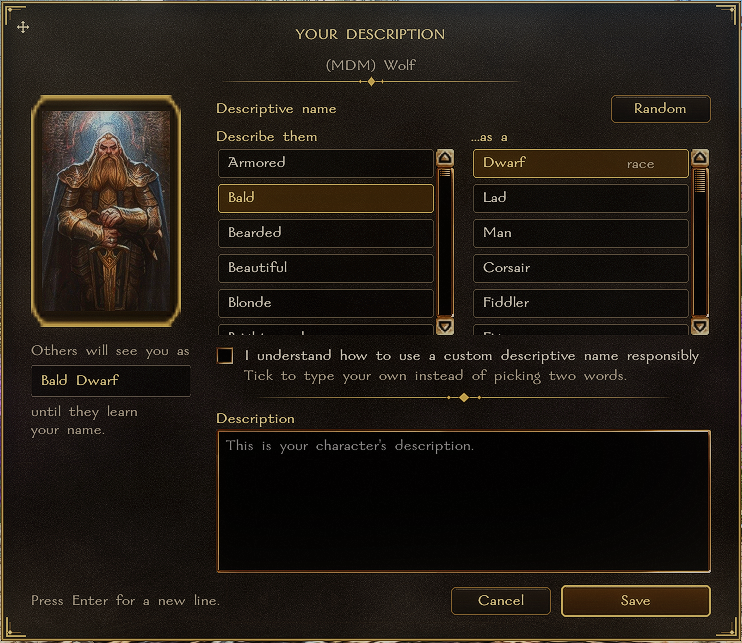
A custom Descriptive Name follows the same rules as naming someone: it describes how your character looks to a stranger. It is not a place for your real name, titles nobody could see, or out-of-character notes.
Changing your Descriptive Name only changes what new people see. Anyone who has already named you keeps the name they gave you.
¶ What else people might see
Instead of a name, you will sometimes see one of these:
- Hooded Figure: they are wearing a hood and are more than 20 metres away. Players can also choose to keep their face hidden at any distance while hooded, with Hide face in the Player Settings (or
!hideface). Party members always see each other's names. - Unseen Presence: you can hear them, but you cannot see them.
- Unknown: you can neither see nor hear them. A player can also choose to always read as Unknown when unseen and unheard, with Stay unknown in the Player Settings (or
!stayunknown). - A creature's name: someone who is shapeshifted shows as the creature they have become. You can name a shape too, and that name never leaks onto the person underneath.
¶ Seeing through a hood
When you examine a hooded figure, you roll Spot against their Hide ranks + 10. On a success, their examine window tells you who you suspect is under the hood (by the name you know them as). If you fail, you cannot try again on that person for an hour.
¶ Disguises
Sometimes, you don't want people to know who you are. Whether you're doing something secret or just enjoy living a double (or triple!) life, who are we to judge?
A disguise is a whole second persona: its own face, portrait, description and Descriptive Name. People who meet you in a disguise name the disguise, separately from the real you.
¶ Getting a disguise
You need one of these to put a disguise on:
-
A prepared Disguise Kit. Kits can be found or crafted. The first time a kit is used, it is prepared with a Perform check (DC 10); anyone can prepare a kit for you. Your Perform roll becomes the kit's disguise DC, written in its description. If the check fails, the kit loses a use. Each disguise you put on uses one more, and the Wardrobe shows how many uses are left.
-
The Disguise Self spell (1st level). Your disguise DC is a Spellcraft roll, with bonuses for illusion focus and specialisation:
- Illusion specialist: +2
- Universalist (general) wizard: +1
- Spell Focus (Illusion): +2
- Greater Spell Focus (Illusion): +4
The spell opens the Wardrobe, so put the disguise on right away. Closing the window ends the casting.
¶ The Wardrobe
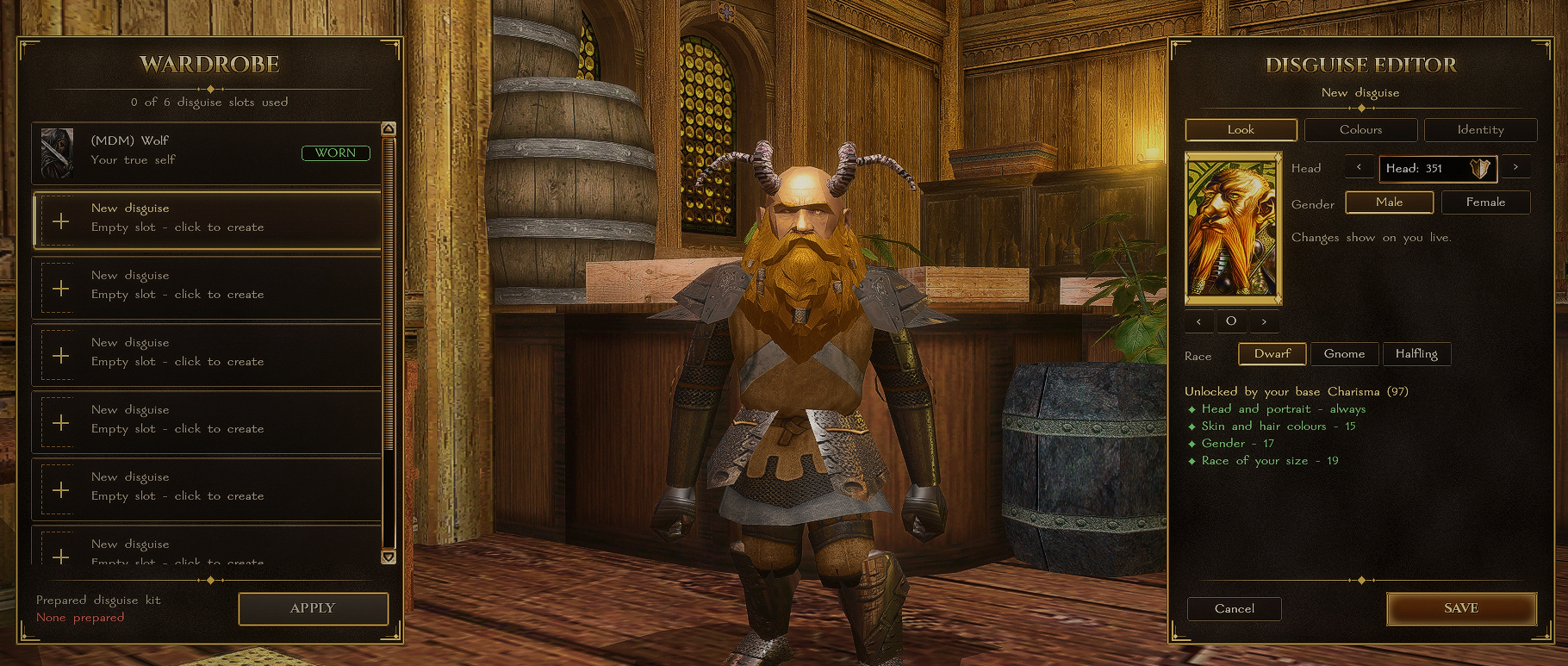
The Disguise Wardrobe opens when you use a kit, cast Disguise Self, or press the Disguise tool on your toolbar.
- Your true self is the first card. Choosing it and pressing Apply takes your disguise off. This needs no kit or spell.
- Each disguise slot is a card showing its portrait, its name and the Descriptive Name others will see. The one you are wearing is tagged Worn.
- Empty slots say click to create.
- Selecting a slot opens the Disguise Editor beside the Wardrobe, where you set:
- Disguise name: your own label for it, only you see this.
- Descriptive Name: what strangers see while you wear it.
- Description: what people read when they examine you.
- Head and portrait.
- Advanced options, unlocked by your base Charisma (see below).
All three of name, Descriptive Name and description are needed to save. Save keeps your changes; Apply saves and puts the disguise on, which needs a prepared kit or the spell.
You can edit a disguise again later. Its slot keeps its identity: anyone who has already named that disguise keeps the name they gave it.
¶ How many disguises you can have
You have a number of disguise slots equal to:
- your Charisma modifier,
- +1 for every 10 ranks of Influence,
- +2 with the Master Disguiser feat,
with a minimum of 1 and a maximum of 6.
¶ Advanced disguises
Your base Charisma (not boosted by items or spells) unlocks more of the editor:
| Base Charisma | Unlocks |
|---|---|
| 15+ | Skin and hair colours |
| 17+ | Gender |
| 19+ | Race, within your own size: medium races (Human, Half-Elf, Elf, Half-Orc) or small races (Dwarf, Gnome, Halfling) |
Anything you have not unlocked is simply not saved with the disguise.
Take off your headwear before using the disguise system.
¶ While you are disguised
- Others see your disguise's Descriptive Name and can name the disguise. From then on they know your disguise by that name and the real you by whatever they named you before. The two are never linked.
- Your description switches to the disguise's. When you take the disguise off, your own description comes back. Edits you make to your description while disguised are kept with that disguise.
- Your disguise stays on until you take it off, through area transitions, logging out and server resets, whether it came from a kit or the spell.
¶ Being seen through
When someone examines you while you are disguised, they roll Spot against your disguise DC:
- Fail: nothing is shown, and they cannot try again on that disguise for an hour.
- Succeed: their examine window notes that you seem to be disguised.
- Beat your DC by 5 or more: it also tells them who they suspect is underneath (by whatever name they know the real you).
Being seen through never removes your disguise. It is up to them what they do with the suspicion.
¶ Taking a disguise off
- Open the Wardrobe (Disguise tool on your toolbar), choose Your true self and press Apply, or
- Type
!removedisguise.
¶ Do not abuse this
DMs always see the real you, and the logs always know who is playing. Disguises are for intrigue and roleplay, not for attacking people and hoping to get away with it. All server rules still apply while disguised, and abuse can lead to a ban.
¶ Frequently Asked Questions
- Can I tell different people different names?
- Yes. Just make sure your character's actual name (the one set at creation) is the name they were really given at birth.
- Can I name myself a bunch of random characters?
- No.
- Can I name someone if I only remember their name from a previous character?
- No. Only use what your current character has learned in play.
- I changed my Descriptive Name, why does my friend still see the old one?
- Because they named you. A Descriptive Name is only what strangers see.
- Do people who named my disguise find out who I really am?
- Only if they see through it on examine (beating your disguise DC by 5) or you tell them in roleplay.
- Do I need a kit to take a disguise off?
- No. Use the Wardrobe's Your true self or
!removedisguise.
- No. Use the Wardrobe's Your true self or