¶ 
"A sword is only as good as the hand that forged it, and the hand is only as good as the many swords that came before."
Haze features a deep, interdependent crafting system. Every character can take up to 5 primary crafts and 2 secondary crafts, but the best results come from those who devote themselves to a single trade. Primary crafts make the reagents and parts the other crafts rely on, so a thriving town needs crafters of every kind working together.
New to crafting? Pick a crafting background (it gives you a Skill Tome), gather the ingredients for a recipe, put them in the matching station and craft. Read Your First Craft for a walkthrough.
¶ Overview
| Topic | In short |
|---|---|
| Crafts | 5 primary crafts, 2 secondary, each tied to an ability |
| CXP and levels | Crafting spends CXP, which refills each hour and levels your craft |
| Effective Crafting Level | Your craft level plus your ability modifier |
| Difficulty | How hard a recipe is for you: cost, risk and eureka chance |
| Skill Tomes and blueprints | Your book of recipes. Lose it and you lose them |
| Eurekas | Discover new blueprints while you craft |
| Masterworks | Spend extra CXP for an exceptional item |
| Pure crafters | One primary craft means better results; many crafts mean penalties |
| Reverse engineering | Sketch a blueprint from an item you hold |
| Repairs | Fix worn gear at a station, in the field, or with magic |
¶ The Crafts

¶ 
 (INT) Alchemy: potions, dyes, reagents and other useful utility.
 (CON) Blacksmithing: armour, weapons, ammunition and upgrades.
 (DEX) Leatherworking: light armour, clothing, furniture and upgrades.
 (WIS) Tinkering: jewellery, containers, traps, tools and more.
 (DEX) Woodworking: furniture, bows, ammunition, staves and wands.
¶ 
 (WIS) Cooking: food, drink and sweets!
 (Survival skill) Survival: rudimentary tools, weapons and clothing, plus survival tasks such as lighting fires and pitching tents.
Secondary crafts never count against you. Taking Cooking or Survival does not cost you your pure crafter status or add multi-craft penalties.
¶ Crafting Experience (CXP)

Crafting runs on CXP (Crafting Experience Points).
- Every hour, +1 CXP is added to your CXP pool.
- The pool holds up to 60 CXP by default. Some classes and feats raise the cap, and pure crafters gain +1 to the cap for each level in their craft.
- Crafting spends CXP from your pool and puts it into your craft, which is how your craft levels up.
- Each successful eureka also grants 4 CXP.
¶ Unfinished projects
You need at least 1 CXP to start a primary craft project. If you can't afford the whole cost, you get an Incomplete Project item that keeps your progress. Use it near the right crafting station when you have more CXP to keep working on it.
¶ Secondary crafts
Cooking and Survival earn CXP at their own rates, depending on the item's difficulty and tier. If you would rather not level them, you can turn off secondary CXP gain in the settings menu.
¶ Crafting sheets
Crafting sheets can be found as loot. Using one opens a window where you can study it into one of your crafts:
- Each sheet gives +100 CXP to the chosen craft (+200 for a secondary craft).
- Sheets only teach the early levels: they do nothing once a craft reaches level 15.
- You can Study one, Study all at once, or Discard sheets you don't want.
¶ Effective Crafting Level (ECL)
Each craft is tied to an ability score. Your ability modifier adds to your craft level for crafting purposes without changing the level itself. The total is your Effective Crafting Level (ECL), and it is what every recipe checks against.
Example: a blacksmith with Blacksmithing level 2 and a +3 Constitution modifier has an ECL of 5. They still need the CXP for level 3 to level up, but they craft as if they were level 5.
To see your level, use your Skill Tome on itself. It shows Current Skill Level: 5 (2), meaning a craft level of 5 and a +2 modifier, for an ECL of 7.
¶ Practice makes perfect
The more often you make a specific item, the easier that item becomes for you. Every 20 successful crafts of the same item count as one extra level for that item only. A veteran tanner who has stitched a hundred leather belts makes them far more easily than their level alone suggests.
¶ Difficulty
Every recipe has a crafting level. How hard it is for you depends on the gap between that level and your ECL, and difficulty decides how much CXP the craft costs, how likely something goes wrong, and your chance of a eureka.
The examples below assume a base cost of 4 CXP.
| Difficulty | CXP cost | CXP needed | Chance of a negative outcome | Eureka chance |
|---|---|---|---|---|
| Effortless | Normal | 4 | None | 50% |
| Very Easy | Normal | 4 | 6.25% | 25% |
| Easy | Normal | 4 | 12.5% | 10% |
| Normal | Normal | 4 | 25% | 5% |
| Above Average | +50% | 6 | 50% | None |
| Hard | +100% | 8 | High, and several can happen | None |
| Very Hard | +200% | 16 | Guaranteed, and several can happen | None |
| Impossible | Cannot be attempted | - | - | - |
¶ Your ECL against the recipe
This is how a recipe with a crafting level of 10 feels at different ECLs:
| Impossible | Very Hard | Hard | Above Average | Normal | Easy | Very Easy | Effortless | ||||||||
|---|---|---|---|---|---|---|---|---|---|---|---|---|---|---|---|
| < 2 | 2 | 3 | 4 | 5 | 6 | 7 | 8 | 9 | 10 | 11 | 12 | 13 | 14 | 15 | 16+ |
In short: every 2 levels of ECL above the recipe makes it one step easier, and every 2 levels below makes it one step harder.
¶ Crafting Stations
Crafting happens at stations around the island: forges and anvils, tanning racks, alchemy benches, woodworking tables, tinkering benches, kitchens and more. Each station serves one craft.
- Stations come in tiers. Higher-tier recipes need a better station.
- Access varies: some stations belong to guildhouses, others are public, and a smith may charge you a fee to use their anvil and furnace.
- You need to stand at the station (within a couple of steps) to craft.
¶ Skill Tomes and Blueprints

¶ Blueprints
Every craftable item has a blueprint, its recipe. Blueprints can be bought, found as loot, discovered through eurekas, reverse engineered, or scribed and shared by other players.
A blueprint only fits the Skill Tome of its own craft: a dagger blueprint goes in a Blacksmithing tome, a bow blueprint in a Woodworking tome.
¶ Skill Tomes
Your Skill Tome is your book of recipes. Each craft has its own, and you cannot craft without it.
- Add a blueprint: use your tome on the blueprint.
- Open your recipes: use the tome on itself. This shows your known recipes and your crafting level.
The recipes belong to the tome, not to your character. If your tome is lost, stolen or destroyed, every recipe in it goes with it.
¶ Getting a Skill Tome
You can start with one by choosing the matching crafting background. Otherwise:
- buy one from an NPC shop, or
- ask an experienced crafter of your trade to copy theirs for you (see Copying a tome).
¶ Copying a tome
A crafter can copy their whole Skill Tome for someone else, using paper, ink and a quill.
- A pure crafter can copy their tome from level 8.
- Everyone else needs 2 more levels for each extra primary craft they hold (level 10 with two primary crafts, level 12 with three, and so on).
- Survival tomes cannot be copied.
¶ Death and your tomes
Dying is hard on your notes. When you die, each Skill Tome you carry has a 55% chance to be destroyed outright. In a tome that survives, each blueprint has a 75% chance to be torn out. Carrying more than two tomes makes both chances 3% worse for each extra tome.
Keep spare copies safe at home, and think twice before carrying your whole library into danger.
¶ Your First Craft
¶ 
Here is how a tinkerer makes a Silver Amethyst Ring.
- Have your Skill Tome. Jewellery is Tinkering, so you need a Tinkering Skill Tome with the ring's blueprint in it.
- Check the ingredients. Use the tome on itself and find the ring. It needs 1 polished amethyst, 1 silver ingot and 1 coal. The number beside the recipe is the ECL needed to make it at Normal difficulty.
- Go to the right station. In this case, a Tinkering station.
- Put the ingredients in the station and close its inventory. The crafting window opens on its own; if it doesn't, use your tome on itself.
- Find the recipe. The left window lists your recipes by tier, in fold-out categories. Use the search box, or tick Have ingredients to show only what you can make right now. The ring is under Tier II, Jewellery.
- Check the details. The right window shows the recipe: how hard it is for you, each ingredient (green if it's in the station, red if not), what it makes and how many times you have made it.
- Choose your effort. Set the CXP to put in this session, and, if the item can be a masterwork, how much extra effort to spend on one.
- Craft. If something stops you, the Craft button greys out and says why.
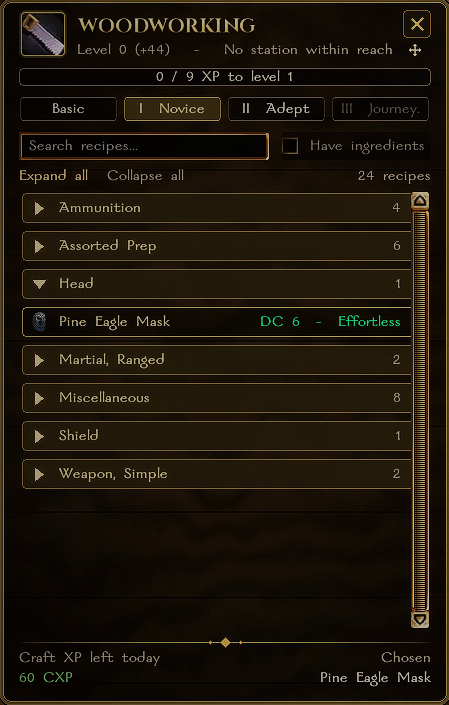
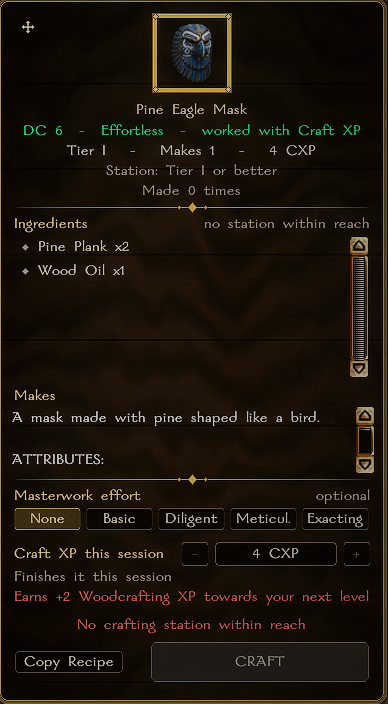
When the craft finishes, open the station again to collect your item.
¶ Eurekas

Sometimes a crafter has a flash of inspiration. When you successfully craft an item, you may have a eureka: a chance to discover a related blueprint you don't know yet, from the same tier or the next one up. The chance depends on the craft's difficulty: 50% when Effortless, falling to 5% at Normal, and none above that. Easy work leaves your mind free to wander.
When a eureka happens, you roll to work out the discovery:
1d20 + ECL + Intelligence modifier against the eureka DC
The eureka DC is 10 + the discovery's difficulty + 2 × its tier (3 × its tier for a next-tier discovery), +3 for Alchemy. The DC itself doesn't fall as you improve, but your rising ECL beats it more and more often.
- If you succeed, a blueprint of your discovery appears in your inventory and you gain 4 CXP.
- You must carry paper, ink and a quill to write it down. Without them, the idea is lost.
- The Expert Innovator feat adds your character level to the eureka roll.
- Next-tier discoveries follow the item's own lineage: they are related to what you were making. Lineages aren't known in character or out of character, so discovering them is part of the fun.
- You can turn eurekas off for your character if you prefer.
¶ Masterwork Items
A masterwork is an exceptional piece made with extra time and care. Not every item can be a masterwork; the crafting window shows when it's possible.
Spend extra CXP on the attempt to improve your odds. The more effort you put in, the better your chances, but success is never guaranteed:
| Effort | Extra CXP |
|---|---|
| Basic | 12 |
| Diligent | 24 |
| Meticulous | 36 |
| Exacting | 48 |
Every masterwork gets:
- double durability;
- two equipment kit slots (see Item Property Changes);
- the maximum roll on every positive skill rating (negative skill ratings still roll normally);
- one random bonus suited to the item, such as better AB, AC or damage, less weight, or a skill or caster rating.
The extra CXP spent on a masterwork attempt is lost, whether it succeeds or not. It does not level your craft; you only gain CXP up to the item's normal base cost.
¶ Improving Skill Ratings
Crafted items that roll a skill rating (for example a hood with Hide +2d4) can be improved afterwards with each craft's specialised tools.
- Each point costs 5 CXP.
- You can raise an item to 75% of the best roll it could have had. That hood can reach 6 out of 8.
This keeps well-made items valuable, while letting you fix a disappointing roll.
¶ Working Together
Several crafters can work on the same project, each putting in their own CXP. The item's quality comes from the CXP-weighted average of everyone's difficulty.
Difficulties count as numbers: Effortless 1, Very Easy 2, Easy 3, Normal 4, Above Average 5, Hard 6, Very Hard 7. Multiply each contribution by its difficulty, add them up, divide by the total CXP, and round to the nearest step.
Example: a master puts in 10 CXP at Effortless (10 × 1 = 10) and an apprentice puts in 50 CXP at Normal (50 × 4 = 200). That's 210 ÷ 60 = 3.5, which rounds to 4, so the item is made at Normal difficulty. The more the expert contributes, the better the result.
¶ Pure Crafters and Multi-Crafting
A pure crafter has levels in only one primary craft. Secondary crafts don't count. Pure crafters are the finest in their trade:
- Better repairs: up to 10 repairs on an item instead of 5, with better results.
- Masterwork attempts on their Effortless and Easy crafts (for items that can be masterworks).
- Copying their tome from level 8 (others need more; see Copying a tome).
- +1 to the CXP cap for each level in their craft.
¶ The multi-craft penalty
Two primary crafts are free. Beyond that, every extra primary craft makes everything you craft 2 difficulty steps harder. The penalty applies after everything else, so no amount of ECL can make a craft easier than the floor it sets. Survival is never penalised.
| Primary crafts | Penalty | A craft that would be Normal | A craft that would be Effortless |
|---|---|---|---|
| 1 | None | NORMAL | EFFORTLESS |
| 2 | None | NORMAL | EFFORTLESS |
| 3 | +2 steps | HARD | EASY |
| 4 | +4 steps | IMPOSSIBLE | ABOVE AVERAGE |
| 5 | +6 steps | IMPOSSIBLE | VERY HARD |
With 4 or more primary crafts, nothing you make can ever be easier than Above Average, so every craft costs extra CXP and risks failure, however skilled you become.
The team may add further benefits for pure crafters over time.
¶ Reverse Engineering
Crafters can study an item and sketch a blueprint from it.
- Carry paper, ink and a quill, and have the item in your inventory.
- Use your Skill Tome on the item.
- Each attempt uses one sheet of paper and one charge of ink, whether it works or not.
Sketching is harder than making: you work at your ECL − 3, measured against the item's crafting level with the usual difficulty steps (the multi-craft penalty and practice bonus apply too).
| Difficulty | Success chance |
|---|---|
| Effortless | 100% |
| Very Easy | 90% |
| Easy | 80% |
| Normal | 60% |
| Above Average | 49% |
| Hard | 25% |
| Very Hard | 10% |
| Impossible | 0% |
Example: a crafter with ECL 10 sketching an item with crafting level 10 works at ECL 7, three below the item. That's Hard, a 25% chance. At ECL 13 it would be Normal, a 60% chance.
- Tip: if you have no chance at all, the game tells you before using anything up.
- Uncraftable items can't be reverse engineered. You get a message and lose nothing.
- Other crafts' versions: you can't sketch an item that belongs to another craft, even if you know a matching recipe. A woodworker can't sketch a Sheet of Parchment (Tinkering), even though they make Scrap Paper (Woodworking).
- You can try as many times as you like.
¶ Repairing Equipment

Crafters can repair worn items that fall within their own craft.
- Repair kits, used at a crafting station, give the best repairs. Results depend on your ECL and the item's complexity, and you can only repair items up to the quality you could craft yourself. Each repair costs 4 CXP, which also counts towards your craft, a handy way to level when you're short of materials.
- Field repair kits work anywhere but repair less, and can be used on an item up to 5 times.
- Magical repairs with the Mending spell need no craftsman, but only restore an item by one condition step and no further than Good.
- Repair limits: an item can be repaired 5 times by non-pure crafters, or 10 times by a pure crafter.
¶ Quick Tips
- Read the right-hand crafting window before you craft: it tells you the difficulty, what's missing, and why a craft can't be made.
- Effortless and Very Easy crafts are where eurekas happen. Keep paper, ink and a quill on you.
- Keep a spare copy of your Skill Tome somewhere safe.
- Stick to one primary craft if you want to be the best at it; two is the most you can take without penalties.
- Crafting sheets are a quick start for a new craft. Save them for crafts below level 15.
- Team up: an expert's CXP lifts the quality of a shared project.